

Every cup of coffee in the world traces its roots to one place: the ancient highlands of Yemen. Here is the story of how a single plant changed civilization.
African Origins
Born in the wild forests of Ethiopia
Coffee as we know it — Coffea arabica — did not emerge from human cultivation. Scientists have traced its origins to a spontaneous hybrid event in the wild forests of what is now western Ethiopia, near the Keffa Zone. Two wild species, Coffea canephora (Robusta) and a low-caffeine tree called Eugenioides, crossed naturally to produce Arabica — a botanical accident that would reshape the world.
"Likely well known locally and consumed for centuries prior to outside influence, the historical question of when coffee was first introduced to the rest of the world is still unsatisfactorily answered."
Local Ethiopian communities cultivated and consumed coffee for generations before any outside world knew it existed. It was only after it made the journey across the Red Sea to Yemen that coffee's global story truly began.
Yemen's Role
The birthplace of coffee culture
Yemen — then known as Arabia Felix — became coffee's first cultivated home. It was Sufi imams in the port city of Aden who first brought coffee into popular use, no later than the mid-15th century, drinking it during late-night religious vigils to stay alert.
From the famed port of Mokha (Moka), Yemen held a commercial monopoly on the world's entire coffee supply for nearly two centuries. Every cup drunk in the Ottoman Empire, Egypt, Persia, and eventually Europe, passed through Yemeni hands.
The Yemenia Mother Population
A remarkable discovery reported in 2020 confirmed a genetically distinct "Yemenia" population of coffee trees — lineages altered by centuries of isolation and traditional practice in Yemen's mountain villages, unlike any other coffee on earth.
Here’s the world-renowned English barista/entrepreneur/YouTuber, James Hoffmann, talking about it…

Yemenia: Bigger than Gesha?
The Global Journey
How coffee traveled the world
Yemen's monopoly could not last forever. Over centuries, through trade, theft, and colonial ambition, coffee spread across every continent.
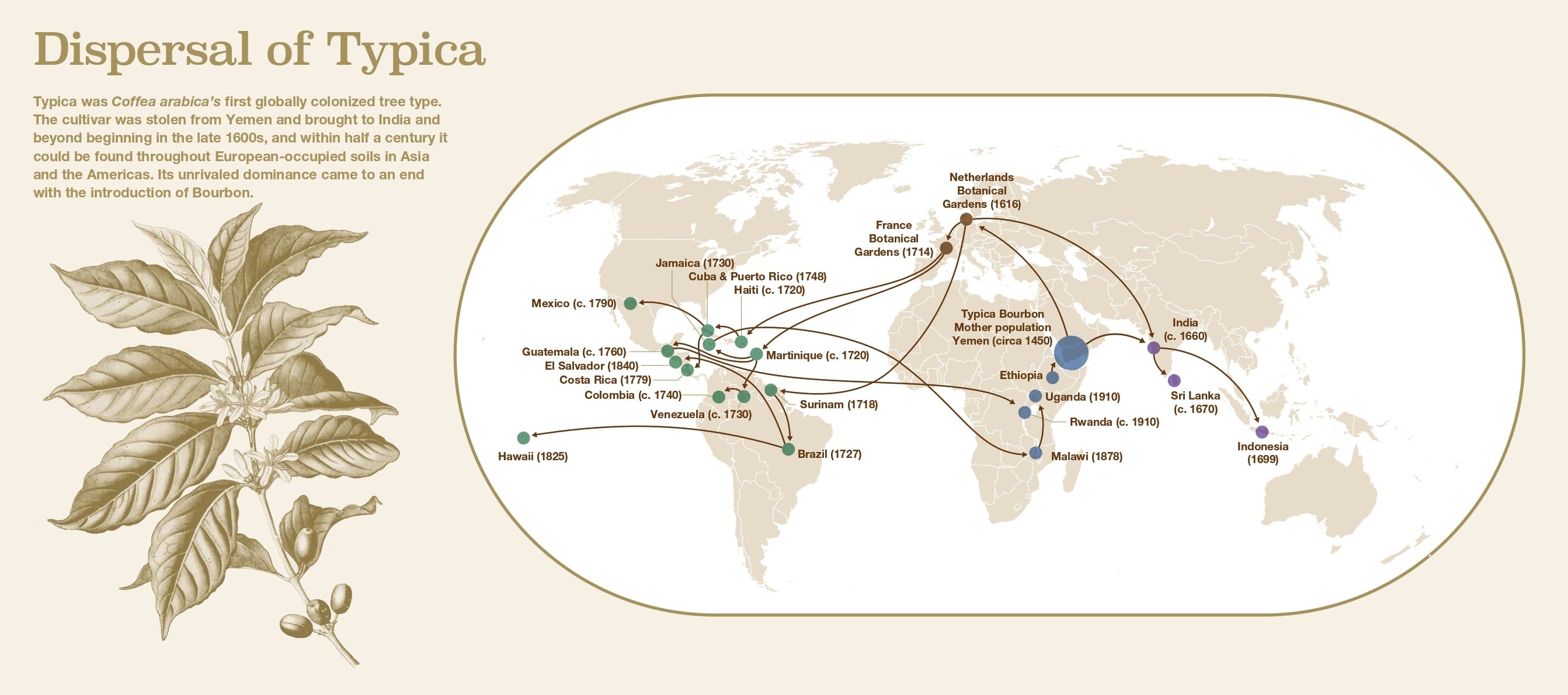
- c. 1450 Yemen — The first cultivation: Sufi imams in Aden begin brewing coffee. The port of Mokha becomes the world's sole exporter of green coffee beans.
- 1616 Netherlands — The first theft: Dutch merchant Pieter van den Broecke smuggles a live coffee tree from Mokha to the Amsterdam Botanical Garden, breaking Yemen's monopoly.
- c. 1670 India — The monk's seeds: Indian Sufi monk Baba Budan smuggles seven coffee seeds from Yemen to the hills of Karnataka, planting the first coffee on the Indian subcontinent.
- 1699 Indonesia — Java is born: The Dutch bring Typica seedlings to Batavia (now Jakarta). After failed attempts, coffee thrives across the Indonesian islands — giving the world the word "java."
- 1715–27 Americas — Coffee crosses the Atlantic: From French and Dutch botanical gardens, coffee reaches Martinique, then Surinam, then Brazil — the country that would become the world's largest producer.
- 1880s+ Global dominance: Bourbon and Typica cultivars from Yemen's original stock spread through Latin America, East Africa, and Asia. By the 20th century, coffee is grown on six continents.
Where it grows today
From Yemen to the world
The Americas produce 59% of global Arabica. Africa contributes 11%. Asia accounts for 30%. All descended from Yemen's original trees.
🇾🇪 Yemen
Origin of all cultivated Arabica. Yemenia landraces still grown in mountain villages using centuries-old traditions.
🇧🇷 Brazil
World's largest producer. 63.5 million 60kg bags annually. Typica and Bourbon roots.
🇨🇴 Colombia
12.9 million bags. Introduced c. 1740. Known for washed Bourbon-derived varieties.
🇪🇹 Ethiopia
Coffee's wild birthplace. Wild Arabica still grows in the Keffa Zone forests today.
🇮🇩 Indonesia
10.9 million bags. Java, Sumatra, and Sulawesi — all from Typica brought via Dutch traders.
🇬🇹 Guatemala & C. America
Coffee introduced c. 1760–1840. Bourbon dominates, producing many prized specialty lots.
The Cultivars
Two branches, one Yemeni tree
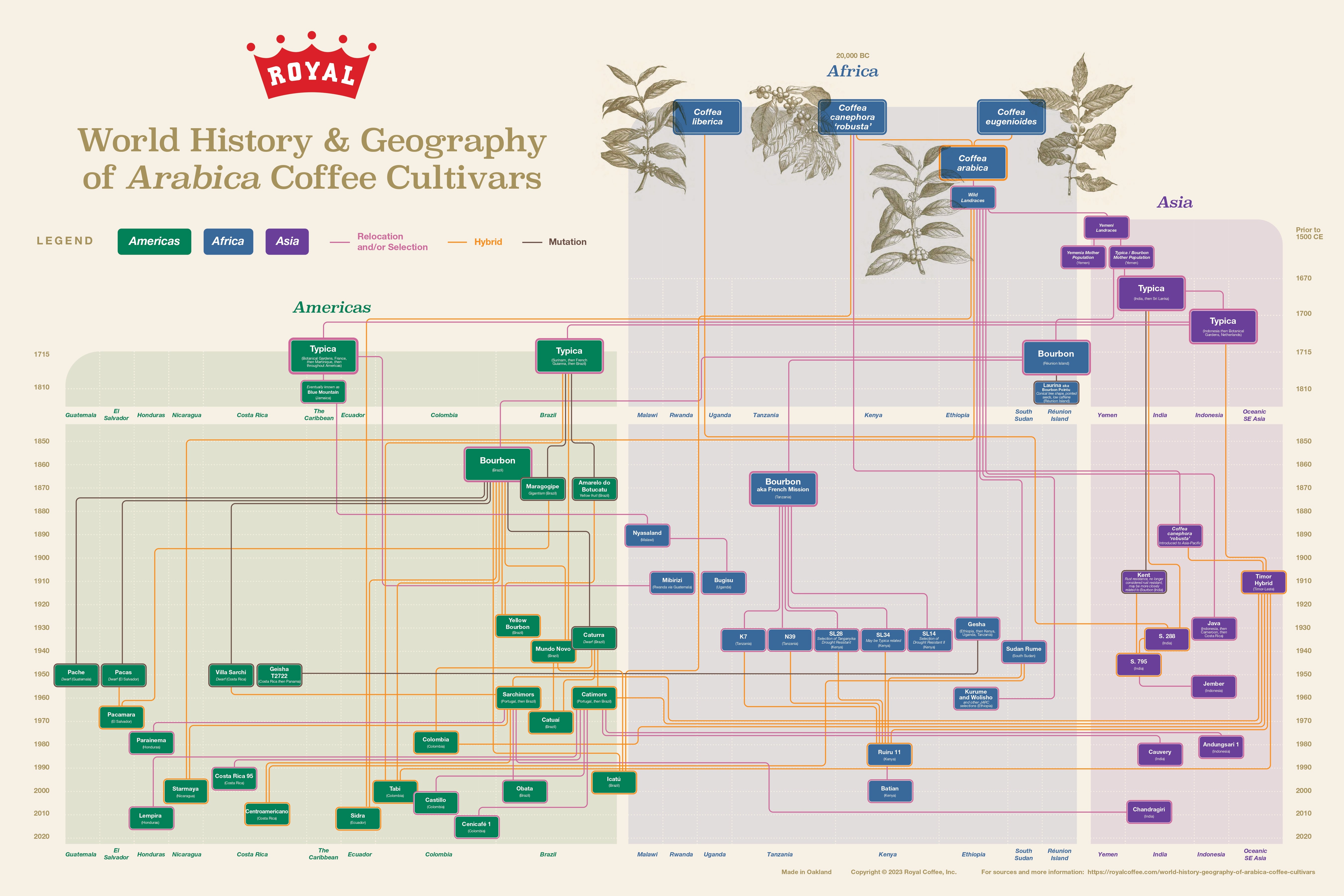
All of the world's major Arabica coffee varieties descend from just two cultivar lines that left Yemen — Typica and Bourbon. Every Geisha, every Pacamara, every Catuaí in your favorite café is a descendant of Yemen's original trees.
Typica
Arabica's first globally colonized variety. Taken from Yemen to India, then Indonesia, then the Americas. Elegant, delicate cup profile. Parent of Blue Mountain, Geisha, Maragogipe, and dozens more.
Bourbon
Introduced to Réunion Island (then Bourbon) in 1715 from Yemen. Its higher yield made it the dominant global variety by the early 1900s. Parent of Caturra, Mundo Novo, Yellow Bourbon, and many others.
Yemenia
A living treasure: genetically distinct Yemeni landraces that never left their homeland. Confirmed as a separate lineage in 2020. These are the trees Yemen Specialty Coffee sources from today.
Geisha / Gesha
Originally collected from Gesha, Ethiopia — transported to Costa Rica, then Panama. Now the world's most celebrated specialty coffee. A distant cousin of the Yemeni tree.
Taste where it all began.
Yemen Specialty Coffee sources directly from the mountain villages where coffee was first cultivated — sun-dried on rooftops, just as it has been for 600 years.
Historical content sourced from:World History & Geography of Arabica Coffee Cultivarsby Chris Kornman, Royal Coffee, Inc. © 2024